
A hydroxyapatite toothpaste proposal usually arrives as a headline: a percentage, the word nano, and a claim about enamel. That is not enough to quote, label or ship against. Hydroxyapatite is a particle, not a single ingredient, and its documentation depends on shape, size distribution, coating and the intended use of the finished product. This guide lists the documents and declarations an overseas buyer should request before accepting a specification.
It is a purchasing framework, not a formulation recommendation or a statement about what any product does. Where the framework asks for a number, the supplier has to provide it under its own test method.
1. "Nano hydroxyapatite" is not yet a specification
Hydroxyapatite is the mineral phase associated with tooth enamel, and it can be supplied in different particle forms and with different surface treatments. Two proposals can both say "nano hydroxyapatite toothpaste" while differing in what was measured, on which batch, and against which limit. The specification work is separating those claims into fields a third party can check.
Ask for the material identity first, then what has actually been measured on it. A shape or size claim without a method is a description, not evidence.
2. Particle characterisation is the core document
For a particulate ingredient, the useful evidence describes the particles as delivered. Request the characterisation report and check which technique produced each value, whether it was measured on the raw material or the finished paste, and which batch it covers.
| Characterisation field | What to ask for | Why it matters to the buyer |
|---|---|---|
| Particle morphology | Declared shape, with the microscopy or imaging report behind it | Shape drives how a market assessment applies to the material |
| Size distribution | Measurement method, reported range and the statistic used (median, percentile range) | A single number hides the spread that reviewers question |
| Aspect ratio | Whether an aspect-ratio distribution was measured, and how it was derived | Several frameworks treat elongated particles differently |
| Agglomeration state | Whether primary particles or agglomerates were measured | Changes what the number actually describes |
| Surface treatment | Coating or surface modification, with the material used | Coated material may sit outside an assessment made for uncoated material |
| Purity and contaminants | Assay, heavy metals and microbiological limits for the batch | Standard specification hygiene for any oral-care input |
| Batch identity | Batch or lot number linking the report to the delivered material | Without it, the report may describe another production run |
Our 7.5% Nano Hydroxyapatite series shows the products we supply as catalog references. A product name is a starting point for discussion; the specification for your order still has to come from the material and formula actually proposed.
3. Learn from how a regulator framed the question
The European Commission's Scientific Committee on Consumer Safety published a final opinion on hydroxyapatite (nano) in oral cosmetic products on 23 March 2023. Its public summary describes a safety conclusion limited to material with defined characteristics — rod-shaped particles with a stated aspect-ratio distribution, and particles that are not coated or surface modified — and states that the opinion does not apply to needle-shaped particles. The same summary notes that no data were provided on inhalation exposure, so the opinion does not cover sprayable products.
Read that as a template for your own questions, not as a claim about your product. The regulator did not accept "hydroxyapatite" as a single safe category; it accepted a shape, a distribution and an uncoated surface, and excluded an application route. A supplier who cannot state those characteristics for the proposed material cannot tell you which assessment, if any, applies to it.
4. Separate the raw material file from the finished product file
Two files are often confused. The raw material file describes the ingredient and its supplier. The finished product file describes the toothpaste as sold: formula, declared content, manufacturing site, stability, microbiological limits and the claims on the pack. Ask for both, and keep them apart in your own records so a later formula change does not silently invalidate a document.
For the finished product, ask how the declared hydroxyapatite content is verified in routine production, which parameter is measured, how often, and what triggers a re-test. Our sample evaluation checklist covers recording a sample against a written specification; for a particulate active, add the batch link between the characterisation report and the delivered paste.
5. Track every document on one page
Documents expire, get revised and get replaced. A buyer's file should show which revision is current for the order in front of them, and what each document does not cover. Keep the material file and the finished-product file apart, so a later formula change cannot silently invalidate a document.
| Document | Field to record | Open question to close |
|---|---|---|
| Material specification | Reference, revision, date, issuer | Which formula revision uses this material version? |
| Characterisation report | Method, statistic, batch, laboratory | Was it measured on raw material or finished paste? |
| Coating declaration | Coated or uncoated, material used | Does any assessment relied on assume an uncoated surface? |
| Safety data sheet | Revision and hazard statements | Does it describe the raw material or the finished product? |
| Finished product specification | Declared content, test method | How is the declared content confirmed per batch? |
| Stability data | Conditions, duration, parameters | Does the shelf life on the artwork match the tested period? |
| Claim support file | Claim, ingredient, evidence, reviewer | Which reviewer approved the wording for this market? |
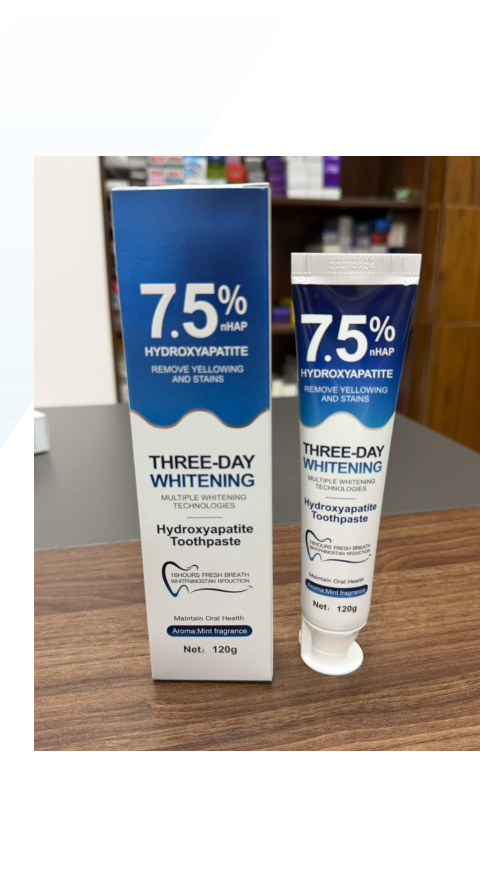
6. Match each claim to a document
Hydroxyapatite products tend to carry claims about repair, remineralisation or whitening. For each sentence that will appear on the pack, ask which ingredient is responsible, which document supports it, and who reviewed the wording for the country of sale. Where a claim depends on a study, ask for the study, the product it tested and the conditions.
The American Dental Association's toothpaste overview separates active ingredients that carry recognised therapeutic roles from abrasive agents that may physically remove surface stains. Use that separation when you sort your own claim list, and keep protection or repair wording out of finished copy until its evidence is in the file.
7. Name the market before finalising the specification
The same tube can be straightforward in one market and require extra documentation in another, because nanomaterial rules, labelling duties and claim regimes differ. Before artwork release, confirm the destination market, the responsible person or importer, the languages required, and which notification the importer must file. Ask which reviews the supplier has already performed, and list what stays with the importer.
Use our artwork approval checklist to keep design sign-off separate from the technical and market review, and our quotation comparison guide so that two suppliers are compared on the same documentation scope, not only on price per tube.
8. Next step
Send us the destination market, the proposed SKU, the intended positioning and your open documentation questions. We will answer with the material and product documents we can provide, the items that need confirmation, and the parts that stay with your importer. Send your hydroxyapatite specification questions, or start with the wider factory sourcing process.